
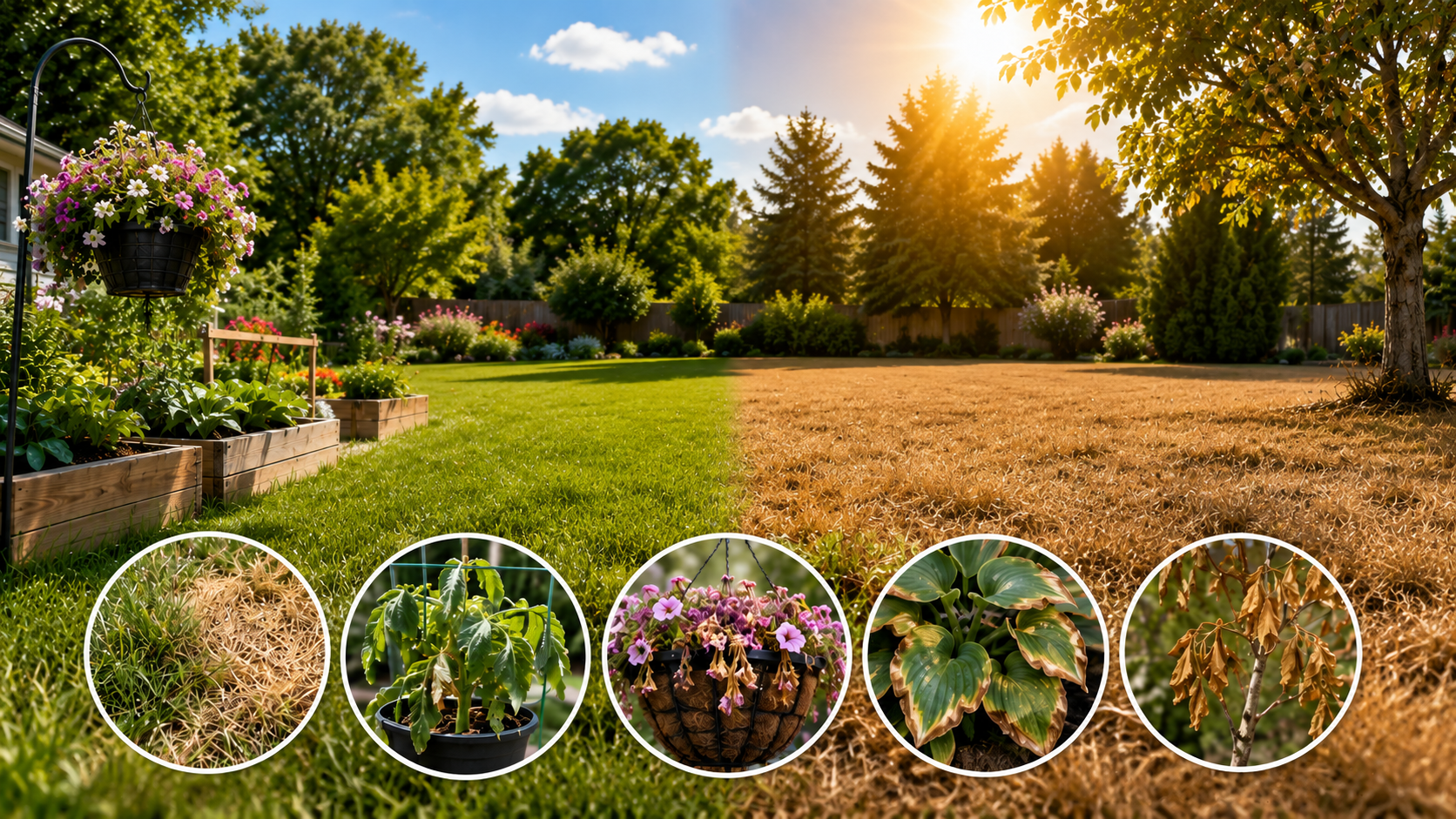
I walked outside this morning and realized my yard suddenly doesn’t look like it did just a week ago.
The lush green lawn now has patches of straw-colored grass. Flower baskets that were overflowing with blooms are drooping. Leaves are beginning to curl. My hostas look sad and droopy. Bushes are developing crispy brown edges.
Even plants that normally thrive during summer seem to be struggling.
In this article:
- PART 1 – Why So Many Midwest Yards Are Turning Brown This Summer
- PART 2 – How to Save Your Lawn, Garden & Landscape During a Midwest Heat Wave
- PART 3 – Avoid The Biggest Mistakes Homeowners Make During a Hot, Dry Summer
👇 Scroll down to the part you need.
If you live in Wisconsin—or much of the Midwest—you may have noticed exactly this happening during the past several weeks.
I certainly have.
After spending many countless hours:
- building new raised garden beds from scratch using leftover wood
- breaking down and laying out every cardboard box I’ve been saving for years
- hauling wheelbarrows full of mulch in 90-degree temperatures
- carrying bags of soil, raised garden soil and topsoil
- planting summertime vegetables
- making hanging flower containers and pots
…. just trying to create the backyard I’ve always wanted, it became impossible not to notice how quickly the weather began changing everything.
Some days reached into the mid 90s.
Rain became scarce.
The ground felt dry almost immediately after watering.
Plants that looked perfectly healthy one day suddenly appeared stressed only a few days later.
Even experienced gardeners can begin wondering: “Am I doing something wrong?”
The good news?
Probably not.
Much of what you’re seeing is actually your landscape doing exactly what nature designed it to do.
PART 1 – Why So Many Midwest Yards Are Turning Brown This Summer
Extreme heat doesn’t just make people uncomfortable.
It fundamentally changes how plants survive.
When temperatures climb into the upper 80s and 90s—especially for multiple days in a row—plants enter survival mode.
Instead of focusing on growing flowers, producing vegetables, or creating lush green grass, they begin conserving every drop of moisture they can.
Think of it like your phone entering Low Power Mode.
Everything unnecessary shuts down until conditions improve.
That means plants often:
- stop growing
- wilt during the afternoon
- drop flowers
- slow vegetable production
- curl their leaves
- develop brown edges
- become more vulnerable to insects
- become more susceptible to disease
Meanwhile, your lawn is doing something similar.
Your Grass May Not Actually Be Dead
One of the biggest misconceptions homeowners have is assuming brown grass equals dead grass.
In many cases, it doesn’t.
Most cool-season grasses found throughout Wisconsin—including Kentucky Bluegrass, Fine Fescue, and Perennial Ryegrass—have evolved to survive drought.
Rather than continuing to grow and eventually dying from dehydration, they intentionally enter a dormant state.
Dormancy is essentially nature’s survival strategy.
During dormancy, grass:
✓ stops growing
✓ turns tan or brown
✓ conserves energy
✓ slows root activity
✓ waits for cooler temperatures and rainfall
Once moisture returns, many lawns green back up surprisingly quickly.
That doesn’t mean every brown lawn will recover, but it does mean patience is often one of the best tools you have.
Why Everything Seems To Be Struggling At Once
One thing I noticed while working outside this summer was that it wasn’t just my lawn showing signs of stress.
It seemed like everything started changing almost simultaneously.
- The hanging baskets needed water far more often than they had earlier in the season.
- Vegetable plants looked noticeably wilted by afternoon, even after morning watering.
- Some shrubs began developing brown tips.
- Even areas that normally stayed green were starting to lose color.
That isn’t a coincidence.
Different plants simply show heat stress in different ways.
| Plant | Common Heat Stress Symptoms |
|---|---|
| Lawn | Brown patches, dormancy |
| Tomatoes | Leaf curl, blossom drop |
| Cucumbers | Wilting during afternoon |
| Hostas | Brown leaf edges |
| Hydrangeas | Drooping blooms |
| Hanging baskets | Dry soil within hours |
| Arborvitae | Browning interior needles |
| Young trees | Curling leaves |
| Newly planted shrubs | Wilting despite watering |
Why Watering Doesn’t Always Solve the Problem
One of the most confusing things about drought stress is this:
You can water…
…and plants may still look stressed.
That doesn’t necessarily mean the watering isn’t working.
During extreme heat, plants can lose water through their leaves faster than their roots are able to replace it.
This is why many plants wilt during the hottest part of the afternoon but appear perfectly healthy again by evening or the following morning.
It’s similar to us sweating on a hot day.
The temporary wilting is actually a protective response.
If the plant recovers overnight, that’s usually a good sign.
If it remains wilted day after day, additional intervention may be needed.
Signs Your Plants Are Heat Stressed (But Still Recoverable)
Look for these encouraging signs:
- Leaves perk up in the evening.
- New growth is still appearing.
- Stems remain flexible.
- Leaves are green underneath.
- Roots are firm and white.
- Flowers continue opening.
- Vegetable production continues, even if slower.
These are all indicators that your plants are fighting through the stress rather than dying.
Quick Checklist: Is It Heat Stress or Something More Serious?
Before assuming the worst, ask yourself these questions:
✔ Have temperatures been above 85–90°F for several days?
✔ Has rainfall been scarce recently?
✔ Does the plant recover overnight?
✔ Is the soil dry several inches below the surface?
✔ Was the plant recently transplanted?
✔ Is the browning mostly on leaf edges or exposed areas?
If you answered “yes” to most of these, heat and drought are likely the primary culprits.
However, if plants continue declining despite cooler weather and adequate watering, pests, disease, root damage, or nutrient deficiencies may also be involved.
PART 2 – How to Save Your Lawn, Garden & Landscape During a Midwest Heat Wave
Should You Water Your Lawn…Or Just Let It Go Brown?
This is probably the biggest question homeowners ask during a hot, dry summer.
The answer is:
It depends on what you’re trying to accomplish.
If your goal is simply to keep your lawn alive, many established Wisconsin lawns can safely go dormant for several weeks. Dormant grass may look brown, but it’s conserving energy and waiting for cooler weather and rain.
However, if your goal is to keep your lawn looking green all summer, you’ll need to water much more consistently.
General guideline for established lawns:
- Water deeply rather than lightly.
- Aim for about 1 inch of water per week, including rainfall.
- Water early in the morning (roughly 5–9 a.m.) when evaporation is lowest.
- Avoid watering every day for a few minutes. Frequent shallow watering encourages shallow roots that struggle during drought.
My experience this summer: I noticed that the ground looked dry again surprisingly fast after watering. That’s because intense heat and dry air can pull moisture from the soil much faster than we normally expect, especially in sunny areas.
Your Vegetable Garden Needs Different Care Than Your Lawn
One mistake many homeowners make is treating everything in the yard the same.
Your lawn, vegetable garden, flower beds, hanging baskets, shrubs, and trees all have different watering needs.
Raised Garden Beds
Raised beds are wonderful because they drain well—but during a heat wave, that’s also their biggest weakness.
The soil warms faster and dries out more quickly than traditional garden soil.
If you have raised beds like I do, you’ll probably notice that they need checking almost every day during prolonged hot weather.
Instead of watering on a schedule, check the soil by sticking your finger 2–3 inches down.
If it’s dry at that depth, it’s time to water.
My Garden Was Finally Coming Together…
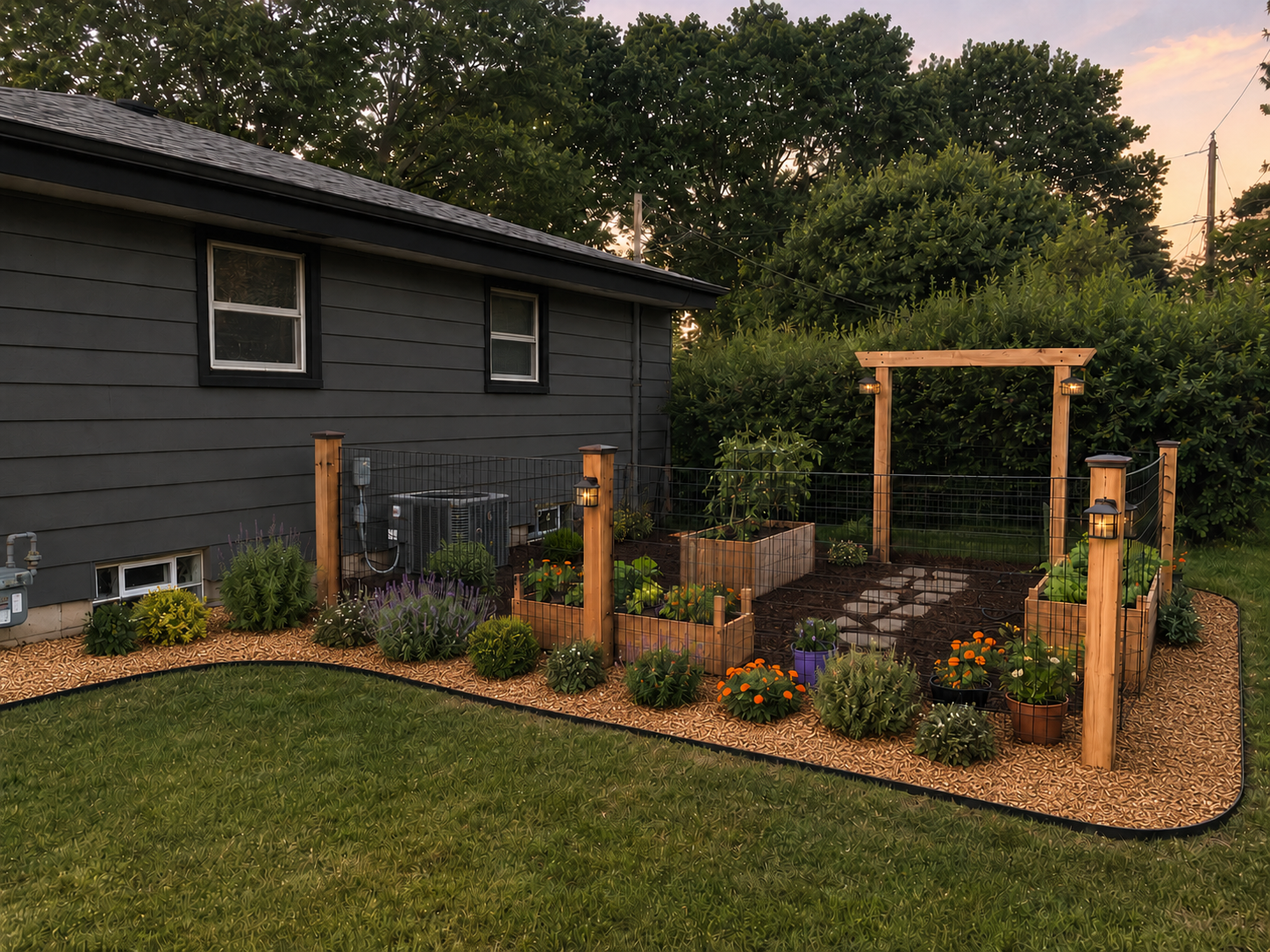
One of the frustrating parts of this summer is that I had spent weeks creating the garden I’d been planning.
- I built new raised beds.
- Moved wheelbarrow after wheelbarrow of mulch.
- Planted vegetables.
- Designed flower containers.
- Added herbs.
Started organizing everything exactly how I wanted it.
Then came the stretch of hot weather with very little rain.
It almost felt like the weather was testing everything I’d worked so hard to build.
If you’ve spent hours planting, landscaping, or creating your dream yard, seeing plants suddenly wilt can be discouraging.
Fortunately, heat stress doesn’t automatically mean you’ve failed as a gardener. In fact, almost every experienced gardener has watched healthy plants struggle during an unusually hot summer.
Why Hanging Baskets Dry Out So Fast
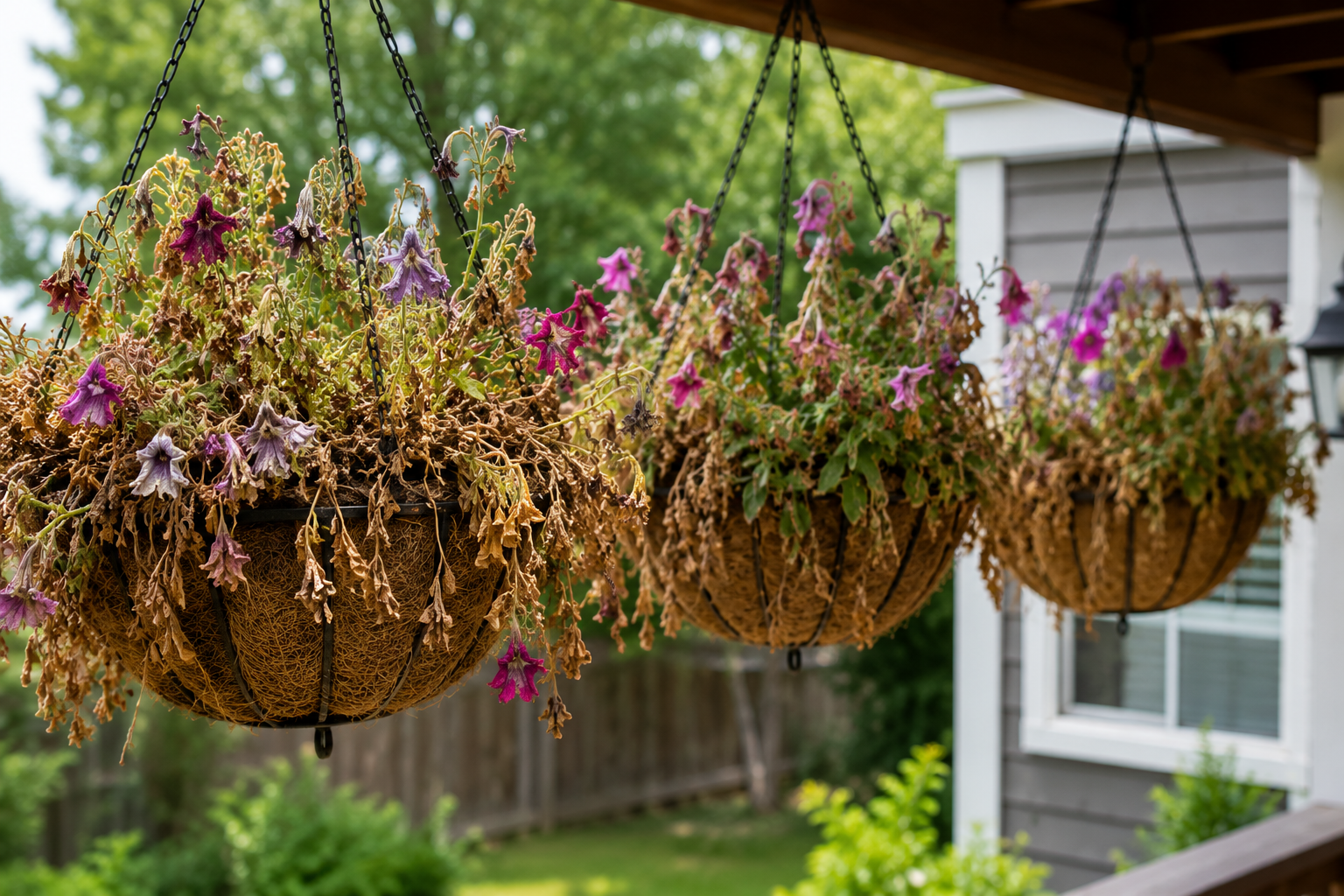
If there’s one thing that taught me how quickly heat affects plants this year, it was my hanging baskets.
Some afternoons they looked perfectly healthy in the morning…
…and completely exhausted by late afternoon.
That’s because hanging baskets are exposed to heat from almost every direction.
Unlike plants growing in the ground, hanging baskets have:
- less soil
- warmer root temperatures
- more wind exposure
- faster evaporation
- quicker nutrient loss
During extended heat waves, some baskets may even require watering twice in one day.
Helpful tip
Lift the basket.
A surprisingly lightweight basket usually means it’s dry.
After a while you’ll be able to judge moisture just by picking it up.
Don’t Panic If Plants Wilt in the Afternoon
One of the biggest mistakes people make is assuming afternoon wilting means the plant desperately needs water.
Sometimes…
It doesn’t.
Many plants temporarily wilt during the hottest part of the day simply because they’re losing water through their leaves faster than their roots can replace it.
Watch what happens after sunset.
If they recover overnight, that’s actually a sign the plant is coping.
If they’re still wilted the next morning, then it’s time to investigate.
Mulch Became My Best Friend
After spending so much time hauling mulch this summer (and getting quite the workout doing it), I gained a whole new appreciation for what mulch actually does.
It’s easy to think mulch is mostly decorative, but it may be one of the best investments you can make during a drought.
Mulch helps:
- slow evaporation
- moderate soil temperature
- reduce weed competition
- protect beneficial soil organisms
- reduce watering frequency
- minimize soil splashing onto leaves
- improve overall soil health as organic mulch breaks down
Even a 2–3 inch layer can make a noticeable difference during hot weather.
Should You Water During the Middle of the Day?
This is one of the biggest gardening myths.
You’ve probably heard:
“Never water during the afternoon.”
The reality is more nuanced.
Morning is still the ideal time because less water evaporates, and leaves have time to dry before evening.
But if your plants are showing severe stress in the middle of a heat wave:
watering them is far better than waiting until tomorrow morning.
The important thing is to:
- Water the soil—not just the leaves.
- Water slowly so it soaks in.
- Focus on the root zone.
- Avoid creating constantly soggy soil.
A thirsty plant benefits far more from an afternoon drink than from following an outdated rule while it continues to dry out.
Trees and Shrubs Often Show Stress Later
One thing many homeowners don’t realize is that trees and shrubs often don’t react immediately to drought.
Sometimes the damage doesn’t appear until weeks later.
Watch for:
- brown leaf edges
- curling leaves
- premature leaf drop
- interior browning on evergreens
- smaller leaves
- early fall color
Young trees and shrubs planted within the last two or three years are especially vulnerable because their root systems haven’t fully established.
Don’t Forget the Roots
Most people focus on what they can see—the leaves.
The real battle is happening underground.
Healthy roots need:
- oxygen
- moisture
- cooler soil
- room to grow
When soil becomes extremely hot and dry, roots slow down dramatically.
That’s why watering deeply is usually much more beneficial than giving plants a quick sprinkle every evening.
Signs Your Yard Is Beginning to Recover
After temperatures moderate or rain finally arrives, look for these encouraging signs:
✔ Bright green new leaves
✔ Fresh vegetable growth
✔ Flowers beginning to bloom again
✔ New grass blades emerging
✔ Firm stems
✔ Improved leaf color
✔ Increased pollinator activity
Recovery often happens gradually rather than overnight, so don’t expect everything to bounce back at once.
10 Quick Ways to Help Your Yard Survive a Heat Wave
If you’re short on time, these simple steps can make a big difference:
- Water deeply instead of lightly.
- Water early whenever possible.
- Add 2–3 inches of mulch around plants.
- Pull weeds that compete for moisture.
- Delay fertilizing stressed lawns.
- Harvest vegetables regularly.
- Provide temporary shade for delicate plants if possible.
- Check hanging baskets daily.
- Avoid heavy pruning during extreme heat.
- Be patient—many plants recover once temperatures cool.
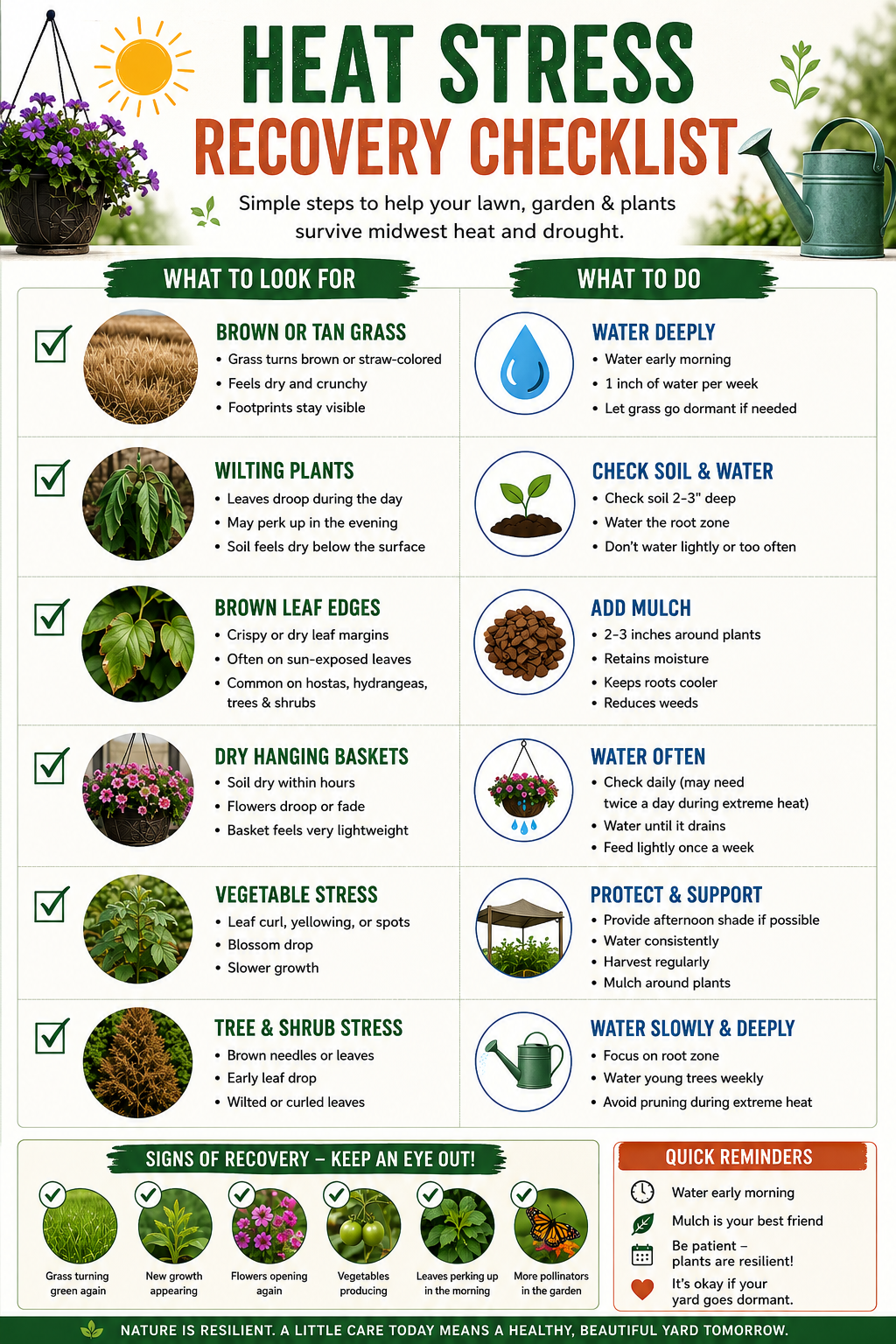
🌿 Heat Stress Recovery Checklist
Save or print this checklist so you’ll know exactly what to look for and what to do the next time your lawn or garden starts showing signs of heat stress.
Did You Know?
Here are some quick facts:
🌿 Grass can survive weeks of dormancy and still recover after rain.
🌿 Plants can lose more water through their leaves on a hot afternoon than their roots can absorb.
🌿 Dark mulch can lower soil moisture loss dramatically compared to bare soil.
🌿 Raised beds often dry out much faster than in-ground gardens.
🌿 A wilted plant isn’t always a dying plant.
🌿 Overwatering during a heat wave can sometimes cause as many problems as underwatering by reducing oxygen around the roots.
PART 3: The Biggest Mistakes Homeowners Make During a Hot, Dry Summer
When your lawn starts turning brown and your favorite plants begin to wilt, it’s tempting to do something—anything—to save them.
Unfortunately, some of the most common reactions can actually make things worse.
1. Watering Too Often (But Not Deeply)
It feels logical to give your plants a little water every day, but frequent shallow watering encourages roots to stay close to the surface, where the soil dries out the fastest.
Instead, water thoroughly so moisture reaches several inches into the soil. This encourages deeper, stronger roots that are better prepared for future heat waves.
2. Fertilizing Stressed Plants
When plants are struggling to survive, adding fertilizer can create even more stress.
Think of it like asking someone to run a marathon when they’re already dehydrated.
Wait until temperatures moderate and the plant shows signs of active growth again before applying most fertilizers.
3. Pruning During Extreme Heat
It can be tempting to remove every brown leaf.
Resist the urge.
Even damaged leaves continue providing shade for stems and developing growth underneath. Wait until the weather improves before doing major cleanup.
4. Assuming Brown Means Dead
This is probably the biggest misconception.
Many plants naturally sacrifice older leaves to protect newer growth.
Grass frequently goes dormant.
Perennials often look terrible in July and beautiful again in September.
Patience is one of the most underrated gardening skills.
How to Tell If a Plant Is Dead or Just Stressed
Before digging something up, do a quick health check.
- Try the “Scratch Test” – Use your fingernail to gently scratch a small section of stem.
- Green underneath? – Great news—the plant is still alive.
- Brown and dry all the way through? – That section may be dead, but continue checking farther down the stem before giving up.
Here’s a quick comparison:
| Heat Stressed | Dead |
|---|---|
| Wilts in afternoon | Never recovers |
| Green stems | Brown stems |
| New growth | No growth |
| Leaves perk up | Brittle branches |
Check the Roots
If possible, gently inspect the roots.
Healthy roots are usually:
- white
- cream-colored
- firm
- moist
Dead roots often appear:
- black
- mushy
- brittle
- hollow
- foul-smelling
Watch for New Growth
Sometimes the best indicator is simply waiting a week or two.
Tiny new leaves or shoots often appear long before the rest of the plant looks healthy again.
When Rain Finally Returns…
One good soaking rain can completely change how your yard looks.
After several dry weeks, don’t be surprised if:
- your lawn begins greening within days,
- perennials send out fresh leaves,
- vegetables suddenly grow faster,
- hanging baskets perk up,
- pollinators return in greater numbers.
Recovery doesn’t always happen overnight, but nature is remarkably resilient.
A Few Things I Learned This Summer
One unexpected lesson from this summer was realizing just how connected everything in the landscape really is.
I originally thought I was just building a vegetable garden.
But over the past several weeks, I found myself paying much closer attention to every part of the yard.
- The lawn.
- The shrubs.
- The trees.
- The hanging baskets.
- The mulch.
Even the birds and pollinators seemed to change their routines as temperatures climbed.
It reminded me that gardening isn’t really about controlling nature—it’s about learning to work with it.
Some years are cool and rainy. Some years bring long stretches of heat.
Every season teaches something new.
And honestly, that’s part of what makes gardening so rewarding.
Frequently Asked Questions
Why is my grass turning brown even though I water it?
During prolonged hot weather, grass can lose moisture faster than it can absorb it. Heat stress, soil conditions, watering depth, and drought dormancy can all cause browning even when you’re watering regularly.
Should I water my lawn every day?
Usually, no.
Most established lawns benefit more from deep, infrequent watering than daily light watering.
Can brown grass turn green again?
Yes.
If the grass has gone dormant rather than died, it often greens up after cooler temperatures and adequate rainfall return.
Why are my tomato leaves curling?
Leaf curl is a common response to heat and drought stress. Plants reduce their leaf surface to conserve moisture. If the plant is otherwise healthy, it often continues producing tomatoes.
Is it okay to water plants during the afternoon?
While morning is usually best, severely stressed plants benefit more from being watered than from waiting until the next day.
Should I mow brown grass?
If possible, mow less frequently during drought.
Keep mower blades sharp and avoid cutting more than one-third of the grass height at a time. Taller grass shades the soil and helps retain moisture.
Why are my hanging baskets drying out so fast?
Hanging baskets have much less soil than garden beds, so they heat up and lose moisture much faster—especially during windy, sunny weather.
Quick Heat Stress Checklist
Before assuming the worst, ask yourself:
- Has it been above 85°F for several days?
- Have we had very little rainfall?
- Is the soil dry a few inches down?
- Does the plant recover overnight?
- Is the browning mostly on exposed leaves?
- Was the plant recently planted or transplanted?
If you answered “yes” to several of these, heat stress is the likely cause.
Learn, Plan & Protect
Seeing your yard suddenly turn brown can be discouraging—especially if you’ve spent weeks planting flowers, building raised beds, spreading mulch, or caring for your lawn.
I know that feeling because this summer, I’ve been right there with you.
After hauling wheelbarrows of mulch in 90-degree weather, building garden beds, planting vegetables, arranging flowers, and watching the forecast day after day for rain, it was frustrating to see parts of the yard begin showing signs of stress anyway.
But this experience also reminded me of something important:
- Nature is incredibly resilient.
- Most lawns aren’t ruined.
- Many plants aren’t dying.
They’re simply doing what they’ve evolved to do—protect themselves until better conditions return.
With a little patience, smart watering, and a few simple adjustments, there’s a good chance your yard will surprise you once the weather cooperates again.
And next summer? You’ll know exactly what to watch for and how to respond.
Related Articles on AMFThings
Here is a series of helpful content, including:
- How to Build a Raised Garden Bed for Beginners
- The Best Mulch for Vegetable Gardens and Flower Beds
- Why My Hanging Baskets Were Wilting Every Afternoon (And How I Fixed Them)
- Midwest Vegetable Gardening Calendar: What to Plant Each Month
- How to Tell If a Plant Is Dead or Just Dormant
- Watering Your Garden During a Heat Wave: Myths vs. Facts
- Beginner’s Guide to Companion Planting
- Common Garden Mistakes I Made (So You Don’t Have To)
- My Backyard Garden Makeover: Before and After
- Best Heat-Tolerant Flowers for Wisconsin Gardens


