
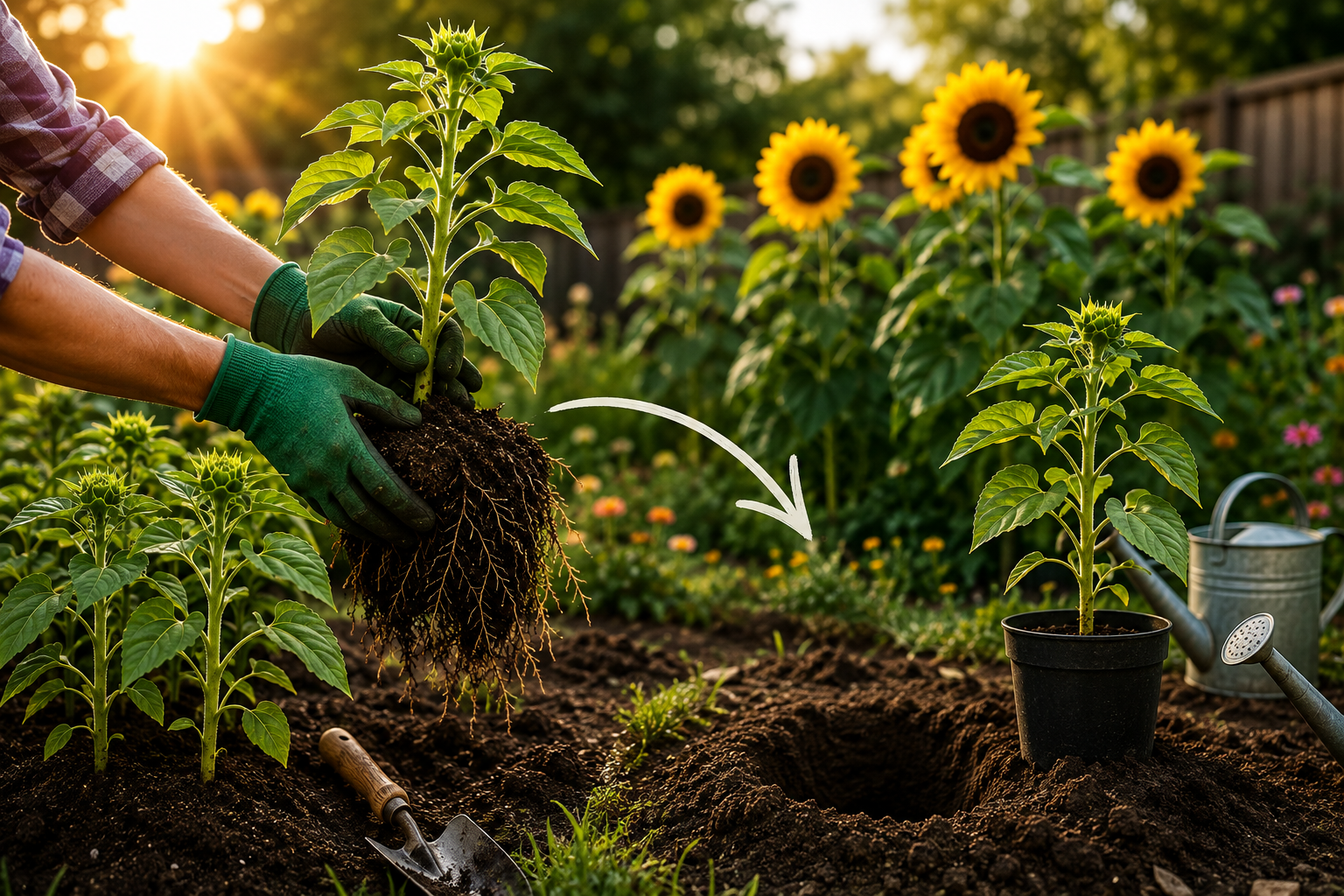
How to Transplant Sunflowers: I Moved Mine at 3 Feet Tall
I had about 10 perfectly healthy sunflowers growing in my first real garden, and I had a problem I hadn’t exactly planned for: they were growing way too close together.
These weren’t tiny seedlings anymore, either. Most were already around 3-4 feet tall, although they hadn’t bloomed yet. Several were growing only inches away from larger, thriving sunflowers that were quickly overshadowing them and competing for the same sunlight, water, nutrients and root space.
So I really had two choices:
- ✂️ Cut out the smaller sunflowers and let the dominant plants have the space.
- 🌻 Try transplanting them and hope at least a few survived.
Considering this is my first year growing sunflowers—and really my first year with a real garden beyond a few buckets and an above-ground plastic planter from Menards—I obviously chose the option that involved digging up 3-foot plants and hoping for the best.
Because apparently gardening has made me optimistic.
Transplanting a 3 foot sunflower is incredibly riskier than transplanting a young seedling
Can You Transplant Sunflowers That Are Larger?
Sunflowers generally prefer to grow where they’re originally planted because they develop substantial root systems and don’t particularly appreciate having those roots disturbed.
That doesn’t mean an established sunflower can’t be moved.
In my case, leaving the smaller plants where they were wasn’t necessarily the safer option. They were so close to larger sunflowers that some were being heavily shaded and crowded.
I wasn’t choosing between moving a perfectly positioned sunflower and leaving it alone. I was choosing between removing the crowded plants completely or giving them a chance somewhere else.
And if you’re going to take that chance, the weather can make a big difference.
☁️ A Cool, Cloudy Day Is a Great Time to Transplant
This may have been one of the smartest parts of my experiment—and thankfully, I actually did it before researching whether it was smart.
I waited for a cool, cloudy summer day after we’d recently had rain.
That gave me several advantages:
- The ground was moist and easier to work.
- More soil stayed together around the roots instead of crumbling away.
- The plants weren’t being blasted by hot afternoon sunshine immediately after losing some of their root system.
- Cooler temperatures helped reduce the additional stress on the plants while they adjusted.
The ideal soil is moist, not soaking wet or muddy. If the ground is saturated enough that you’re squishing through mud, wait until it drains.
🌧️ This is actually one of several garden projects that can be better on a gloomy summer day. I’ll link my separate guide here on what to do in the yard and garden on those random cool, cloudy days.
How I Successfully Transplanted My 3-Foot Sunflowers
The question that I really got stuck on was “Can you transplant a sunflower that’s already 2–3 feet tall?” And what I heard from friends, family, neighbors and online was:
“YES” —but it’s very risky, more than transplanting a young seedling, and protecting the roots becomes especially important.
I wasn’t following some elaborate sunflower-transplanting system when I did this. I was trying to preserve the plants I had and give them enough room to grow.
Here’s exactly what I did, along with what I’d recommend changing now that I know more.
1. I Chose the Sunflowers That Actually Needed Moving
I didn’t move every sunflower.
I focused on the smaller, overshadowed plants that were growing extremely close to larger sunflowers. Most were around 2–3 feet tall and hadn’t developed open flowers yet.
If your sunflower already has adequate space, good sunlight and no compelling reason to move it, I wouldn’t relocate an established plant simply for fun.
This is more of a rescue mission than routine sunflower maintenance.
2. 🌻 I Chose Their New Locations First
Before digging holes, I set the sunflowers near the areas where I wanted them to grow so I could visualize the spacing.
After all, there wasn’t much point in rescuing them from overcrowding only to recreate the same problem somewhere else.
Sunflower spacing varies considerably by variety, so use the mature size listed on your seed packet when possible. Large varieties need considerably more room than compact varieties.
3. I Removed Them While Keeping as Much Root Bulk as Possible
This was the part I was most nervous about.
Because the ground was already soft from rain, I was able to gently but firmly remove the smaller sunflowers while trying to preserve as much of the roots and surrounding soil as possible.
If you’re intentionally transplanting an established sunflower, digging generously around it and lifting the root ball is preferable to pulling primarily on the stem.
🌱 The goal isn’t to get a perfectly clean plant out of the ground. The dirt attached to those roots is your friend.
Keeping the root system intact as much as possible gives the plant a better chance of recovering after the move.
4. I Dug Approximately 10-Inch-Deep Holes
For the root systems I had, my holes were approximately:
- 10 inches deep
- 3–4 inches in diameter
Those aren’t magic sunflower measurements.
Your hole should ultimately be large enough for your particular root system to sit naturally without being folded, curled or crammed into it. If you manage to lift a larger root ball, make the hole wider.
I wanted the roots to have loose soil beneath and around them instead of being squeezed into hard ground.
5. 🌱 I Layered the Soil Before Replanting
This is where my very technical gardening terminology comes into play.
I put approximately one inch of loose topsoil into the bottom of the hole, followed by some of what I kept referring to as my fertilized grow dirt.
What I was actually describing was an enriched planting or garden soil/planting mix—the type of soil product containing added organic matter and/or nutrients.
My basic layering looked like this:
TOP
- Gentle mound of topsoil
- Original surrounding garden soil/topsoil
- Approximately 1–2 inches of enriched planting mix around the root area
- Sunflower roots/root ball
- Light layer of enriched planting mix
- Approximately 1 inch of loose topsoil
BOTTOM
One thing I would be more careful about now is adding concentrated fertilizer directly against freshly disturbed roots. A newly transplanted sunflower is already stressed, and more fertilizer isn’t automatically better.
If you’re using an enriched planting soil, compost or plant starter, follow its directions rather than assuming a giant sunflower needs a giant dose.
🌻 Right after transplanting, the goal isn’t to force fast growth. It’s to help the roots recover and reestablish themselves.
6. I Placed the Sunflower and Gently Backfilled the Hole
I lowered each sunflower into its new hole while trying to keep the roots positioned naturally downward.
Then I covered the roots with approximately 1–2 inches of my enriched planting soil before finishing with topsoil.
I gently filled around the roots rather than packing everything down as tightly as possible.
You want good soil-to-root contact without turning the surrounding ground into concrete.
7. I Made a Small Mound to Help Support the Plant
Remember, these plants already had a couple of feet of sunflower above ground.
That’s a lot different from supporting a four-inch seedling.
Once the hole was filled, I created a gentle mound around the base and lightly pressed the soil so the sunflower could stand securely.
If a larger sunflower can’t support itself after transplanting, a temporary stake may help while the roots establish. Keep any plant ties loose enough that they don’t cut into the growing stem.
8. 💧 I Deep-Watered the Root Zone
Finally, I gave each newly transplanted sunflower a thorough, deep watering.
That wasn’t just about giving the plant a drink. Water also helps settle loose soil around the roots and eliminate large air pockets.
Afterward, I kept an eye on the soil rather than repeatedly soaking it just because the sunflower looked unhappy.
And there’s a very good chance it will look unhappy.
Don’t Panic About Transplant Shock
Moving an established sunflower can cause some pretty dramatic wilting.
Think about what just happened: the plant had an established underground system supplying water to several feet of leaves and stem. Then someone—hello—came along and relocated the entire operation.
Even if you’re careful, some roots can be damaged.
For the first several days, watch the plant rather than judging it by how it looks during the first several hours.
Good signs after transplanting include:
- Leaves beginning to lift after initial wilting
- The stem remaining upright
- Leaves staying predominantly green
- New growth eventually appearing
- The plant becoming increasingly stable in the soil
- Continued development of the flower bud
Keep the root zone appropriately moist during this recovery period, especially if hot weather returns, but don’t keep it continuously waterlogged.
If the next day suddenly turns blazing hot and sunny, temporary afternoon shade can also help a particularly stressed plant get through the transition.
🌻 What If You’re Moving Sunflowers That Haven’t Bloomed Yet?
That’s exactly where most of mine were.
They weren’t tiny sunflower seedlings, but they weren’t mature flowering plants either. They were essentially adolescent sunflowers—already several feet tall but still developing.
And although transplanting earlier would have been easier, I actually preferred attempting the move before they were carrying a large, heavy flower head.
Once a sunflower is mature and blooming, you’re dealing with an even larger plant with a more established root system and significantly more top growth to support.
So if overcrowding leaves you with no choice but to move one, I would rather make that decision while it’s still developing than wait until it’s towering and flowering.
What I Would Do Differently Next Time
The biggest lesson is embarrassingly obvious:
I’d give my sunflower seedlings more room in the first place.
But that’s part of learning to garden.
A seed packet can tell you a sunflower eventually gets huge, but seeing a tiny seedling in several feet of empty dirt somehow convinces your brain:
“Look at all this space!”
Two months later, you discover you accidentally created a sunflower apartment complex.
If I needed to move larger sunflowers again, though, I would use essentially the same strategy with a few refinements:
- 🌧️ Wait for a cool, cloudy day and ideally moist soil.
- 🕳️ Prepare the new holes before removing the plants.
- 🌱 Dig around the original plant rather than relying on pulling it free.
- 🤲 Preserve an even larger root ball whenever possible.
- 🧪 Avoid unnecessarily heavy fertilizer around disturbed roots.
- 💧 Deep-water immediately after planting.
- ☀️ Protect badly wilted transplants from intense afternoon sun temporarily.
- 👀 Give them several days before deciding whether the experiment worked.
The Sunflower That Broke
Of course, I couldn’t move 10 established sunflowers without adding a little drama.
One broke approximately six inches above the ground during the process and fell forward onto the mulch.
I thought it was done.
But when I looked closer, the stalk wasn’t completely separated. Several vertical fibers were still connecting the two sections—almost like breaking celery without snapping all of its strings.
So naturally, instead of accepting defeat, I attempted what can only be described as a sunflower tourniquet.
And that turned into an entirely different experiment.
🌻 I’ll cover what happened to that sunflower—and what happened to all of these transplants—in Part 2: Did My Transplanted Sunflowers Survive?
So, Can You Successfully Transplant a 2–3 Foot Sunflower?
Yes, it’s possible—but there are no guarantees.
Sunflowers aren’t plants I’d recommend routinely moving once they’re established. The safest option is still planting them with adequate spacing from the beginning and letting them grow where they started.
But sometimes your garden doesn’t read the instructions.
If a developing sunflower is severely overcrowded, shaded or otherwise unlikely to thrive where it is, transplanting may be worth the risk.
In my case, those approximately 10 sunflowers weren’t going to get much of a chance squeezed next to the larger plants. Moving them gave them something they didn’t have before:
space, sunlight and a chance.
And considering the alternative was cutting them out completely?
🌻 I’ll take a slightly traumatized sunflower with its own patch of dirt over no sunflower at all.